statement of significance
Dutch Beardman Jugs c.1656
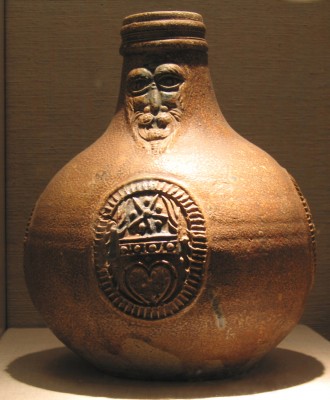
Beardman Jugs, c.1656. Courtesy ANMM

Collection
Australian National Maritime Museum, Sydney, NSW, Australia.

Object Name
Beardman jugs

Object/Collection Description
The jugs are made from glazed ceramic probably to store rum. Beardman jugs are named after the bearded face on the neck. It was excavated from the VOC ship Vergulde Draeck that was wrecked on the Western Australian coast in 1656. This popular style of jug, also known as ‘Bellarmine’, originated in the Germanic areas of Europe in the early 1500s. It’s said to be a mocking likeness of Cardinal Bellarmine, popular with Protestants as a retort to the cardinal’s arguments against Protestantism. Dimensions: unknown.

The most significant exploration of Australia in the 1600s was by the Dutch and is inextricably linked with the expansion of the powerful Dutch East India Company, the Verenigde Oostindische Compagnie (VOC). The VOC established a trade network throughout Asia seeking rare spices, exotic textiles and new markets for their goods. Trade between Europe and Asia was a profitable enterprise.

A Beardman Jug. Courtesy of Western Australian Maritime Museum

Fuelled by the growing myths about the treasures which awaited them in the huge unknown continent in the South, the VOC equipped several expeditions in their search for profit. However, instead of wealth, the VOC found tragedy when the first ships were wrecked on the dangerous west coast of Australia.

The Dutch East India Company traded extensively with the islands which now form parts of Indonesia, and hence were very close to Australia already. Some Dutch explorers include Dirk Hartog who landed on the Western Australian coast, leaving behind a pewter plate engraved with the date of his landing, and Abel Tasman for whom Tasmania was eventually named — he originally called it Van Diemen’s Land after a senior member of the Dutch East India Company. Maps from this period and the early 18th century often have Australia marked as “New Holland” on account of the voyages of these Dutch explorers.

On 4 October 1655 the VOC ship Vergulde Draeck of the Amsterdam Chamber sailed from Texel in the Netherlands on her second voyage bound for the East Indies (now Indonesia). She was carrying, apart from passengers and crew, cargo, trade goods and silver coins worth 185,000 guilders. She reached the Cape of Good Hope on 9 March 1656 and four days later set sail for Batavia. She never reached her destination.

Having adopted the Brouwer route, ie. followed the Roaring Forties east from the Cape, but obviously miscalculating his easting and possibly the latitude, Captain Pieter Albertszoon drove her onto a reef off the western coast of the Southland between the present day towns of Seabird and Ledge Point in Western Australia on 28 April 1656.

On striking the reef the Vergulde Draeck burst open and only a few provisions were saved.

When the 75 survivors had gathered ashore Albertszoon decided to send a party of sailors to Batavia, in the one schuyt (small boat) which had been saved from the wreck, to report the tragedy and ask for a rescue vessel to be sent.

Albertszoon decided to stay with the survivors and to appoint his under steersman (second officer) Abraham Leeman van Santwitz to lead the rescue party. He was probably influenced in his decision by the events following the wrecking of the Batavia on the Abrolhos Islands some 27 years earlier. On that occasion senior officers abandoned the survivors to sail to Batavia, leaving many survivors to be killed by mutineers.

After a remarkable and impressive feat of seamanship and endurance Leeman and his crew reached Batavia on 7 June 1656.

Almost immediately after hearing the news of the wrecking from Abraham Leeman, the Commander of the Council of the VOC dispatched the yacht Goede Hope and the flute Witte Valk to the Southland to search for the wreck and survivors. Both ships failed miserably.

The Witte Valk could not approach land due to rough seas. The Goede Hoop was more persistent and managed to land a search party at the appropriate latitude. Three members of the party got lost in the bush while going inland and were never seen again. Subsequently, a longboat with 8 searchers was smashed on inshore reefs by pounding surf and was also never seen again. The Goede Hoop returned to Batavia soon after this event leaving the 11 men, possibly stranded and marooned, having found no trace of the Vergulde Draeck or its survivors. She reached Batavia on 14 October 1656.

Governor-General Maetsuijke. Courtesy of VOC

In April 1657 another vessel, the flute Vink, sailed from the Cape to Batavia with instructions to call at the Southland and search for survivors. Once again there was no success, primarily due to bad weather and high seas. The Vink reached Batavia on 27 June 1657.

The experiences of the rescue ships with inclement weather along the coast of the Southland convinced Governor-General Maetsuijker in Batavia, that June and July were not the best months for rescue missions. Still concerned about the fate of the survivors, the next expedition was mounted during the summer.

On New Year’s Day 1658 the fluit Waeckende Boei and the galjoort Emmeloort, under the command of Captains Samuel Volkersen and Aucke Pieters Jonck, left Batavia in search of survivors of the Vergulde Draeck and the lost 11 crew from the Goede Hoop. They were instructed to rescue survivors and to salvage as much merchandise – especially coins – as possible and to chart the coast carefully. Furthermore, they were to find out if the land was inhabited and, if so, to try and establish trade with the inhabitants. They were also instructed to take formal possession of all the places they discovered.

Not long into the voyage Volkerson complained that the Emmeloort was too slow and he was having difficulty keeping the vessels together. On February 14 they separated and acted independently although they met up on several occasions on the coast of the Southland.

The Emmeloort sighted the Southland on 24 February 1658 at 33° 12′ S – at about Bunbury – and then sailed north charting the coast. On March 8 at about 30° 25′ S fires were seen on the shore. Next day a boat was sent ashore late in the day to discover that the fires had been extinguished. Next day another search party was dispatched and they met up with a group of aborigines who had been responsible for the fires. The party also reported seeing crops of grain growing and land under cultivation. However, no traces of survivors and wreckage of ships were found. The Emmeloort slowly sailed north and reached Batavia on 18 March 1658.

Volkerson sighted the Southland at 31° 40′ S (near present-day Two Rocks) on 23 February 1658. Sailing past Rottenest Island and noting the submerged reefs between it and the mainland Volkerson lowered a boat which sailed between it and the mainland. The following day they saw fires and a party was sent to investigate. When they returned they reported that the beach was littered with wreckage from the Vergulde Draeck. There were also signs that survivors had been there as they found a circle of planks with their ends planted in the sand.

Sailing north Volkerson made further landings at 31° 14′ S and 30° 40′ S but no wreckage was sighted. After fifteen days of bad weather during which time the Waeckende Boei stayed well out to sea, they returned and anchored at the north-east corner of Rottenest Island. A party was sent ashore and upon its return the helmsman had reported that navigation and landing was difficult due to the abundance of stone reefs. The island was well wooded and the party had seen two seals, and a ‘wild cat’. That information did not encourage Volkerson to explore the island again.

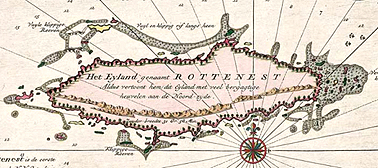
Map of Rottenest Island made by Samuel Volckersen, master of the Wakende Boei, during the search for the 'Vergulde Draeck', 1658. Courtesy of the Western Australian Maritime Museum.
Map of Rottenest Island made by Samuel Volckersen, master of the Wakende Boei, during the search for the Vergulde Draeck, 1658. Courtesy of the Western Australian Maritime Museum.

Volkerson did not name Rottenest Island nor did he take formal possession of it as instructed.

Sailing north a search party made another landing at 31° 09′ S on March 20 and found a beam from the Vergulde Draeck. A second landing was made and more wreckage was found.

The man who had led the search parties to the shore was none other than Abraham Leeman, the upper steersman (first officer) of the Waeckende Boei. This was the same Leeman that two years earlier, as under steersman had survived, not only the wrecking of the Vergulde Draeck, but also a 6 weeks journey in a small boat to Batavia to report the wrecking of the Vergulde Draeck.

Two years after that wreck, Leeman was back on the shore of the Southland, searching for any sign of survival of his fellow crew and passengers from the Vergulde Draeck.

Having been ashore many times and having found wreckage, Leeman set out once again with thirteen men only to return to the Waeckende Boei when he noticed the weather turning bad. On returning to the ship Volkerson disputed Leeman’s concerns and send him back. By nightfall the storm had broken and the sea had risen so high that Leeman and his men were unable to land and were forced to ride out the storm in the darkness of night. The storm worsened the next day and the boat lost a rudder and steering had to be managed by using the oars. Eventually Leeman sighted a small inlet between two rocks and with little control over the boat made for the beach. They landed with considerable damage to the boat.

Meanwhile, the Waeckende Boei had headed out to sea to ride out the storm. After 4 days Volkerson returned to the site where the boat was last seen. He fired cannons but there was no response. He concluded that the boat and crew were lost, presumably drowned and decided to sail back to Batavia. However that evening, March 28, they saw a fire on the land. He discharged a cannon again and immediately another fire was seen close to the first. Not having another boat onboard and convinced that Leeman and his crew had perished, he could not go ashore to investigate. He decided to stay in the vicinity and wait for daybreak. By then the ship had drifted further north and although Volkerson records that he sailed past the shore and that he got close into the coast, nothing further happened that prevented him from sailing north to Batavia, which he reached on 10 April 1658.

During the 4 days the Waeckende Boei was riding out the storm, Leeman and his crew were doing all they could to repair their damaged boat. Keeping a lookout for the Waeckende Boei they survived by killing seals and gulls and drinking brackish water found in the rocks. They returned to the mainland near where wreckage of the Vergulde Draeck littered the beach fearing that they would be stranded there. Then, on the 28th in the evening, sails were sighted and Leeman ordered a fire to be lit. Shortly afterwards, the Waeckende Boei reduced sail and fired a gun to which Leeman responded with a second fire. They could have sailed their boat to the ship but the sea was rough, it was getting dark and the surrounding reefs were of concern. Instead they decided to wait until morning.

But when dawn broke (29 March 1658) the Waeckende Boei was nowhere to be seen. They sailed their boat out to sea trying to find her, but to no avail. They were now marooned. With their spirits low, Leeman had to work hard to convince his men that there was only one solution for their plight and that was to sail to Batavia. For a week they worked to outfit the boat for the long voyage on the open sea.

On the morning of the April 8, 1658 Leeman sailed a leaky craft with fourteen men on board, for 21 days along the barren Western Australian coast and across the Timor Sea to Java for the second time.

When Leeman reached Java and reported his experience to the Governor-General and his councillors, they decided not to mount anymore expeditions to search for the survivors of the Vergulde Draeck.

Two years later Abraham Leeman found the wreck site and again no survivors.

It is remarkable that such a large number of people, which by this time had possibly increased to 79 with the 11 from the Goede Hoop, just disappeared.

The English translation, in 1859 and 1899, of the documents relating to the Vergulde Draeck gave rise to much speculation as to the whereabouts of the vessel and its valuable cargo. In 1931 A. Edwards discovered 40 silver coins in the sand-hills just north of Cape Leschenault. The wreck was not found until 14th April 1963 by a group of spear fishermen.

Following the discovery of the wreck the first material raised and recorded was an elephant tusk (African) and some ballast bricks. However, the wreck site was not protected at this time and the details of the artefacts are only gleaned through contemporary newspaper references. Reports of blasting at the site encouraged State Government intervention and the responsibility for the excavation and protection of the wreck site was vested in the Western Australian Maritime Museum.

Exposure of the site to the Indian Ocean swell made any work undertaken on Vergulde Draeck hazardous. However, in early 1972, a full expedition was mounted to systematically excavate the remains of the cargo and ship’s fittings. Little remained of the vessel’s structure and the site had been disturbed by looters. Over several months a quantity of artefacts was recovered including beardman jugs, ceramic masks and medallions, clay tobacco pipes, bronze and brass utensils (e.g. a bronze mortar with the inscription Amor Vincit Omnia (Love Conquers All), tools and accessories, glass bottles, a tool-box, various armaments and much organic material.

The Beardman Jug is historically significant as evidence of expansion of Europeans onto the west coast of Australia. It sets the moment in time when the existence of the speculated south land was realised. The wreck is an important place significant to the early European exploration of Australia. It demonstrates the difficulties of early navigation and the inability to establish accurate measures for longitude without the aid of a chronometer. The wreck led to further expeditions in search of survivors and encouraged the mapping of the little known Western Australian coastline that became known as ‘The Great Southland’.

The Beardman Jug provides a research tool for historians to contextualise the role of the Dutch in the Age of Discovery.

The Beardman Jug provenance is unknown. It is currently in the collection of the Australian National Maritime Museum, Sydney, Australia. It is one of the oldest European objects in the collection.

The Beardman Jug is rare in that it is one only a few objects from the Vergulde Draeck in public collections.

The Beardman Jug represents the beginning of the European exploration and mapping of the Australian coast that would see the circumnavigation, mapping and naming of Australia by Matthew Flinders in 1802.

The Beardman Jug is in a good condition.

The Beardman Jug’s importance lies in its potential to interpret the early Dutch presence in the Indian Ocean, its trade with Java and the subsequent mapping and exploration of the Australian coast that would culminate in the arrival of the First Fleet and the British settlement at Port Jackson in 1788 and the spread of European settlement across the Pacific.


BibliographyBroese, F.
Island Nation: Australia’s Maritime Heritage,
Sydney, 1998.

Coupe, S. & Andrews, M.
Their Ghosts may be heard: Australia to 1900,
Longman Cheshire, Sydney, 1992.

Regional Histories of NSW,
Heritage Office & Dept of Urban Affairs & Planning,
Sydney, 1996.

Significance: A guide to assessing the significance of cultural heritage objects and collections,
Heritage Collections Council. 2001.

Websites

www.anmm.gov.au/site/
page.cfm?u=178&c=35

www.museum.wa.gov.au/collections/maritime/
march/shipwrecks/Metro/verdra/vergulded.html

www.netherlands-australia2006.com/geschiedenis/
au/html/ontdekkingsreizigers_schipbreuk2.html


Written by S Thompson
August 2007
Migration Heritage Centre NSW

Crown copyright © 2007


Migration Heritage Centre logo
The Migration Heritage Centre at the Powerhouse Museum is a NSW Government initiative supported by the Community Relations Commission.
www.migrationheritage.nsw.gov.au


Powerhouse Museum logo
Regional Services at the Powerhouse Museum is supported by Movable Heritage, NSW funding from the NSW Ministry for the Arts.



The Australian National Maritime Museum is a Statutory Authority of the Commonwealth of Australia.
www.anmm.gov.au